Lo visible y lo invisible
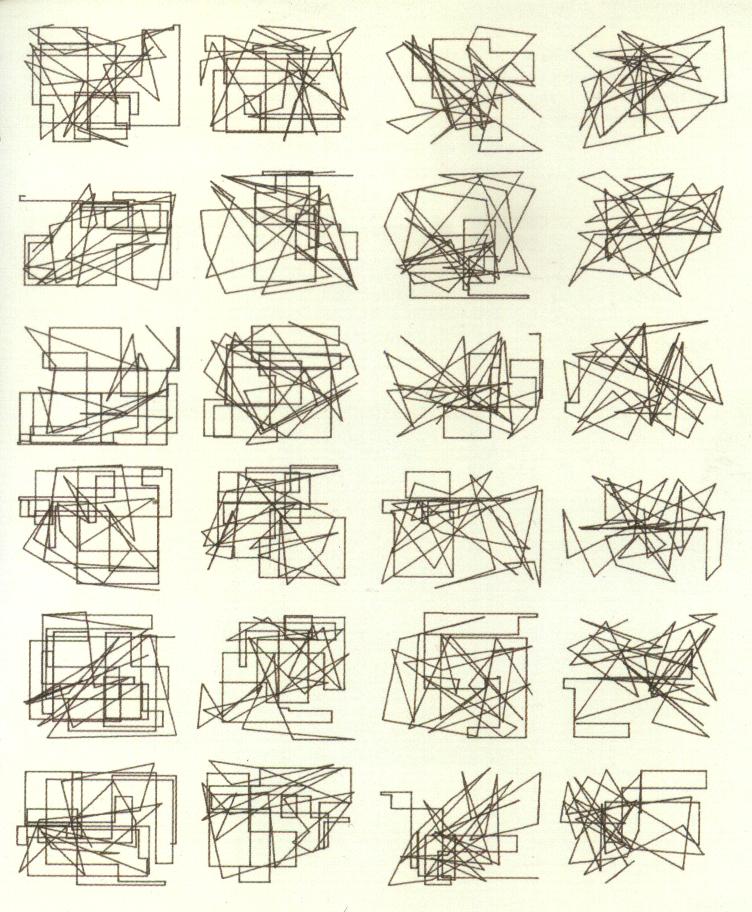
Images created by progressive sequences. This translation is created as we press the mouse button, as a kind of user decision; It makes no difference whether you press the right or left button, images are always being created. The line width variables seek to simulate the Nees plotter and make a distinction between what we see and what we do not see. Images are always being created, they are always looking for you to come and look at them, the latter represented by the white frame, the invisible that somehow wants you to look again and of which you have no decision.
Technical, aesthetic and conceptual development
I took as a reference the mathematician, physicist, engineer, philosopher
Should I say artist?
George Ness, creator of algorithmic art
creator of carefully controlled serial images through repetitive principles.
Did you even think about the aesthetics you would propose with your digital art? or rather with his electronic art, what BREA calls it, JOSE LUIS in BRIEF (AND DISORDERED) ANTIGLOSARY - OR DICTIONARY OF TOPICS ABOUT ELECTRONIC ART
I don’t think I even imagined the influence it would have. The revolution in the production of images, today ready to be reproduced and disseminated on the networks, which by the way the author BREA had also already decreed in his tenth REDEFINITION OF ARTISTIC PRACTICES 21st century
In a note where Ness and LeWitt (Artist) are mentioned, expressions such as “Ideas become a machine that makes art” are added; Idea, machine and work. It sounds to me like that artist who is a producer today, and the ideas (intangible products) that were works.
The voracity with which content is entered/consumed, the time dedicated to it, digital marketing and its meticulously controlled statistics through repetitive principles designed for the user.
The image, content that penetrates, punctures the sound due to your absence on the network.
How much time do you spend on the internet?
and how much actually looking at the image?
Digital marketing and technology managed to appropriate that time and that auditory sense, the sound that PAUL VALERY in THE CONQUEST OF UBIQUITY mentions when talking about the fields of music as an expanded art.
All you have to do is leave your cell phone for 30 minutes for it to ring with updates, email marketing, etc.
It will therefore be our challenge to generate that punctum of the image while contemplating it lasts (Roland Barthes) and to make it memorable (expanded) in terms of the number of senses it penetrates.
Literature
Obra de George Nees “Sin Titulo” 1965 https://proyectoidis.org/wp-content/uploads/2019/01/George-Nees-01.jpg
Válery, Paul. ([1960], 1999). La conquista de la ubicuidad (1928). En Piezas sobre arte. Madrid: Visor, pp.131-133. (DAA: 10m)
Brea Jose Luis - Breve (y desordenado) anti glosario-o diccionario de tópicos-sobre el arte electrónico.